

Ecosystem Feed
News
Official Hyperliquid announcements and HIP-3 ecosystem updates, normalized into one chronological feed.
01 /
News Feed
Jeff · X · 2025-04-05 14:17 UTC
Debunking Hyperliquid FUD (Part 1: HLP, liquidations, and platform guarantees) It's sad to see coordinated misinformation campaigns targeting Hyperliquid, which have led to widespread misunderstanding of what we are all working so hard to build. In response, this series of posts provides detailed, factual explanations of how Hyperliquid works. As a community, we must actively fight FUD by spreading the truth. The tone with which we do this also matters: the best way to grow as a protocol and ultimately house all finance is to remain humble and welcome more users into the ecosystem. -- The first post focuses on HLP and liquidations on Hyperliquid. High level summary The FUD is that the Hyperliquid protocol is subject to large losses stemming from manipulation. On the contrary, Hyperliquid's margining design mathematically guarantees platform solvency. Note that HLP’s losses are isolated to the vault itself, and Hyperliquid does not depend on HLP’s operation to exist. This was true even before the JELLY incident. After the JELLY incident, there is an additional change to protect HLP from losses during backstop liquidations. The fundamental changes are to HLP, not the platform itself. HLP background HLP is a permissionless protocol vault pioneered by Hyperliquid. HLP does not collect fees from depositors, and historically has returned 60M USDC in pnl to its depositors. On CEXs, this profit typically goes to the internal market making desks instead of users. HLP plays two roles: market making and backstop liquidations. In terms of market making, HLP runs a passive strategy that accounts for less than 2% of Hyperliquid's total volume. The vast majority of volume on Hyperliquid is between two non-HLP users. Liquidations On Hyperliquid, liquidations are first sent to the book as a market order. This allows any user to participate in providing liquidity to liquidations, which is profitable flow on average. On other exchanges, this flow is internalized by the exchange as a revenue source. HLP only performs backstop liquidations, which involves taking over positions that are unable to be market liquidated. When account values go negative, the last resort for platform solvency is auto-deleveraging (ADL). ADL closes underwater positions against the most profitable and highly leveraged positions on the other side, ensuring the protocol's solvency. ADL is extremely rare but importantly targets the attacker's position on both sides during manipulation attempts as described below. JELLY incident An attacker recently attempted to exploit HLP by opening a large long and short against themself. Open interest caps allowed a position worth 4M USDC at the time of trade, but the logical issue was that HLP collateralized the liquidation with its full balance. It is false that the platform itself had solvency risks, but HLP was indeed overexposed to the manipulation. Changes made Now the liquidator component vault of HLP has capped collateral, limiting its potential loss by backstop liquidations. A historical analysis was conducted based on this new system. Apart from the JELLY incident, this change would not have caused additional ADLs in the past, even during extreme volatility. However, it would have minimized HLP’s losses during the JELLY incident to low six figures, which is far less than the attacker spent on market manipulation. In particular, ADL would have closed the attacker’s momentarily profitable long position, leaving other JELLY positions untouched. Validators now actively discuss delistings in an open governance forum on Discord. Several interesting dashboards have been created by users and validators: https://stalequant.github.io/hyperliquid_recos.html, https://data.asxn.xyz/dashboard/hl-risk-metrics. Market cap of the underlying spot assets will likely be an important input into delisting considerations. While delistings are important to ensure that users on the platform do not suffer from potential price manipulation, they are not required for platform solvency. New state of margining system and HLP Hyperliquid still functions as before, handling under-collateralized positions in the order of 1) market liquidations 2) backstop liquidations 3) ADL. Backstop liquidations on HLP now have additional protections to cap the total losses, making mark price manipulation attacks more expensive than the limited available gain from HLP. HLP's role continues to shrink as Hyperliquid grows, and at this point is nonessential to the protocol's operation. HLP still exists as a source of protocol yield through backstop liquidations and providing consistent background liquidity.
Jeff · X · 2025-04-05 02:48 UTC
Thanks for having me on lads! Enjoyed the conversation Hyperliquid
@0xSteadyLads
The Lads are hyped for @chameleon_jeff to join for Episode #89 and discuss all things @HyperliquidX 🫡 🚨 OUT NOW on @YouTube & @Spotify! In this Ep we cover: 🎵 Trump Tariffs & The Market 🏗️ The…
Jeff · X · 2025-03-13 16:12 UTC
There's been a lot of discussion on Hyperliquid's margin design. I’ll address some flaws in the common arguments and explain Hyperliquid's first-principles based approach to improving the system. To my knowledge, this is the first such design in margining systems. Perhaps other teams will find it useful for their own logic. Like good theories in physics, the best margining design is simple, canonical, explainable, and works in a wide variety of pathological scenarios. 1. The conclusion of some people has been that there needs to be a centralized force that detects and limits malicious behavior. This completely violates the purpose of defi and everything Hyperliquid stands for. This forces users back to a web2 world where the platform has the final say. True decentralized finance is worth it, even if it is 10x harder to build. Just a few years ago, no one believed DEX/CEX volumes would reach its ratio today. Hyperliquid is leading the charge here and has no intention to stop. 2. Some assume that copying approaches from CEXs will work in defi. The most common suggestion I've seen is per-address margin requirement fraction scaling with position size, as CEXs only offer higher leverage for smaller positions. However, this doesn't work to prevent manipulation attempts on a DEX because a sophisticated attacker can easily open positions on many accounts. Nonetheless, this will help somewhat reduce the impact of "organic whale" positions and is on the list of features to implement. 3. Another suggestion is to implement some features that severely limit usability of the platform in exchange for safety. For example, if unrealized pnl is not withdrawable, many attacks are not possible. Indeed, Hyperliquid pioneered isolated-only perps for illiquid assets which feature this safety mechanism. However, this change would have a crippling effect on funding arbitrage strategies, where unrealized pnl from Hyperliquid needs to be withdrawn to offset the loss on other venues. Real user needs are a top priority in system design. 4. There were also suggestions to innovate on design by having margin settings based on global parameters. However, liquidation prices need to be deterministic functions of price and position size. If global parameters such as open interest were added as inputs to margin requirements, users would lose confidence in the ability to use leverage at all. So what's the answer? We all want defi, but a permissionless system must be robust to manipulation at all scales. The answer lies in understanding the true problem with large positions: they are difficult to mark. The first order approximation of mark price times size breaks down when market impact approaches maintenance margin. It's impossible to accurately simulate market impact because book liquidity is a path-dependent function of time and actions of other participants. Without simulating market impact, it can be possible for liquidation to be a low-slippage way to exit at a price that is unfavorable to the liquidator. Therefore, Hyperliquid's margining system update has the following desirable property: any liquidated position is either a loss relative to entry price, or at least a (20% - 2 * maintenance_margin_ratio / 3) = 18.3% loss relative to the last margin transfer out (using an example of 20x leverage). An organic 20x user who makes 100% return on equity after a 5% move will still be able to withdraw the majority of the pnl without closing the position. However, by introducing separate margin requirements between transfers and opening new positions, profitable manipulation attempts require moving the mark price almost 20%. This kind of attack is infeasible from a capital perspective. Finally, I'd like to point out that the mark price problem also solves itself as market makers continue scaling up on Hyperliquid. It's quite possible that the trader yesterday could have lost money in aggregate. $1.8M pnl longing on Hyperliquid could have been more than offset when pushing the price on other venues, or using other accounts on Hyperliquid. HLP took over an undesirable position, losing $4M. The only market participants who definitely made money in aggregate are the market makers. With millions of dollars of pnl to be made in the span of minutes, it's becoming clear to sophisticated participants that Hyperliquid is one of the venues with the best flow. As liquidity improves, it will become more and more expensive to dislodge prices. So while the margining system improvements will go a long way, the allure of easy pnl attracting market makers will provide an independent source of robustness over time. The future is decentralized. Hyperliquid.
Jeff · X · 2025-03-09 14:15 UTC
Hyperliquid = HyperCore + HyperEVM. One piece of user feedback since HyperEVM’s alpha launch was to more intuitively communicate how the HyperEVM fits into the larger context of Hyperliquid. To this effect, the native pieces of the Hyperliquid execution state have been organized under one umbrella term: HyperCore. HyperCore consists of performant native components: order book perp and spot DEX, staking, oracles, multi-sig, etc. HyperEVM is a general purpose world-computer, allowing builders to deploy code that interacts with both HyperEVM and HyperCore. Together, they form one global, composable state on Hyperliquid, secured by the state-of-the-art HyperBFT consensus algorithm. Importantly, any interaction across the Core/EVM boundary is part of execution itself. There is one unified state, with no need for bridging, proofs, or trusted signers. HyperEVM offers builders a familiar interface to plug into the most powerful permissionless financial system in crypto. Let's walk through some concrete examples. A project XYZ deploys an ERC20 contract on the HyperEVM using standard EVM tooling. They deploy a corresponding spot asset XYZ permissionlessly in the HyperCore ticker auction. Once the XYZ HyperCore token and HyperEVM contract are linked, users can seamlessly transfer their XYZ balance to HyperCore for order book trading. Two key improvements compared to CEX listings: 1) The entire process is permissionless. No behind-the-scenes negotiations for preferential treatment. Hyperliquid is a neutral platform for finance. 2) There is no bridging risk between HyperCore and HyperEVM. On the other hand, CEXs need to manage deposits and withdrawals through wallets that could be hacked. HyperCore and HyperEVM are one unified state. Trading and building on the same chain is a 10x product improvement over CEXs. Let's go further. A lending protocol sets up a pool contract that accepts XYZ as collateral and lends out another token ABC to the borrower. To determine the liquidation threshold, the lending smart contract can read XYZ/ABC prices directly from the HyperCore order books using a "read precompile." For a Solidity developer, this is as simple as calling a built-in function. Suppose the borrower's position requires liquidation. The lending smart contract can send orders directly swapping XYZ and ABC on the HyperCore order books using a "write precompile." Again, this is a simple built-in function in Solidity. In a few lines of code, the lending protocol has implemented protocolized liquidations similar to how perps function on HyperCore. A theme of the HyperEVM is to abstract away the deep liquidity on HyperCore as a building block for arbitrary user applications. As these interactions become available on mainnet HyperEVM, I look forward to seeing the innovative ways that builders leverage these primitives to reinvent finance. These examples only scratch the surface of what is possible. Hyperliquid.
Jeff · X · 2025-02-19 17:24 UTC
Execution Extremely proud of the community and team for the smooth launch of the HyperEVM. The upgrade happened amidst billions of dollars of daily volume, where the majority of defi derivatives trade. There was no downtime, and no performance degradation after the launch. The UX of trading is still so seamless that many users assume the HyperEVM is a separate chain! To be clear: the HyperEVM and the existing native Hyperliquid financial system are one composable state. The safest way to upgrade this uniquely complex system is a gradual rollout. Precompiles and other L1 interactions will build upon the sturdy foundation of the initial HyperEVM release. This will unlock an entirely new class of performant defi applications, but more on that later. Right now I want to focus on the execution of the launch. A bug in HyperEVM logic or an unoptimized code path would've crippled the entire blockchain, affecting hundreds of thousands of users and billions in open interest. This was a massively challenging launch: a jet's engine was flawlessly changed mid-flight. -- Philosophy The HyperEVM launch stayed true to Hyperliquid’s “no insiders” principle. Hyperliquid has always embodied the original ethos of crypto: no investors, no paid market makers, no fees going to any company. The HyperEVM launch is yet another example that integrity and fairness are the pillars of Hyperliquid. The tradeoff of a fair launch is that things are a bit messy to start. Tooling might not be there from day one. Builders need to familiarize themselves with the tech. But these short term obstacles are nothing compared to the long term value of fairness. No one had a head start or unfair advantages. I’m impressed that some teams deployed dapps, tooling, and analytics within hours of the HyperEVM release, a testament to the strength of the builders and community. Hyperliquid will eventually be the credibly neutral infrastructure that houses all of finance. Looking back, the L1 launch, HYPE genesis, and HyperEVM launch will all be important milestones. Success is path dependent, and there can be no blemishes on the fair trajectory towards the final state. The HyperEVM is a clean slate. The community is hungry for quality applications. Where else in the world is there such an imbalance between supply and demand for applications built? Fast, general purpose chains are nothing new. But on Hyperliquid, builders can plug into a mature, liquid, and performant onchain economy with real users. I've noticed a pattern that builders, traders, and communities who "make it" on Hyperliquid are those who call Hyperliquid home. Legacy players don't win just because of their credentials. Newcomers have equal opportunity to win by challenging the status quo and seizing the opportunities. There are empires to be built on the HyperEVM, and the community welcomes builders with open arms. Hyperliquid
Jeff · X · 2025-02-14 16:49 UTC
Excited to see Unit protocol hit mainnet! For the first time, users can trade native assets from another chain using the seamless UX of Hyperliquid. BTC is the most important crypto asset and historically the most difficult to bring to defi. Most wrapped BTC options today involve a single custodian, contradicting the ethos of defi. Unit protocol's guardian architecture is a generalized solution bringing self-custody to a wide range of asset sources. When a user deposits, trades, and withdraws BTC using Unit and Hyperliquid, they maintain full control of their assets at all times. Like Hyperliquid, Unit abstracts away the underlying technological complexity from the end user. Send BTC to an address, and it's ready for trading. Finally a BTC trading solution Satoshi would approve of: trustless and self-custodial, without sacrificing user experience. Unit's launch brings Hyperliquid one step closer to housing all finance. It will be exciting to see Hyperliquid's world class liquidity and UX extend to many more important financial assets.
@unitxyz
Introducing Unit: the decentralized asset tokenization layer for all of finance, built exclusively on Hyperliquid. Unit will enable seamless deposits, withdrawals, and trading for a wide variety of…
Jeff · X · 2025-01-28 01:11 UTC
Noticing a trend that important projects have perps on Hyperliquid before anywhere else Informed traders can no longer afford to stay on CEXs
Jeff · X · 2025-01-19 09:44 UTC
Even after a full day of CEX listings, TRUMP perps on Hyperliquid are doing 44% of the volume of Bybit: $3.25B vs $7.31B over 24h Users are waking up to the crypto-native way to trade
Jeff · X · 2025-01-14 08:42 UTC
integrationIn 2024, Hyperliquid 1) redefined the crypto meta to put community above all. With Hyperliquid, there are no investors, no market makers, and no fees paid to any company. Billions of dollars of value were created by a common vision and relentless hard work. This value went directly to hundreds of thousands of users, building a passionate community with real skin in the game. You all continue to inspire me every day. 2) became the first mature, permissionless financial hub where liquidity and UX matched the most liquid centralized venues. Recent highlights include $15B 24-hour volume, reaching 20% of Bybit futures and 8% of Binance futures volume. Unlike CEXs, Hyperliquid accomplished this as a user-owned protocol. 3) reinvented several of the most entrenched and predatory centralized practices to be crypto-aligned: fair, transparent, and accessible. Examples of the last point: 1) Listings have always been controlled by CEXs that extort projects through listing fees to maximize their own profits. This is absurd, as the community drives long term success. CEXs tempt projects with immediate liquidity but kill their ultimate vision. On Hyperliquid, listings are fair, permissionless, and transparent: anyone can bid in the auction to deploy a new spot asset. Projects that want to control their own fate increasingly see Hyperliquid as one-stop infrastructure for both the tech stack and liquidity. 2) Historically, CEXs capture the lion's share of revenue in crypto. On Hyperliquid, builders are already bootstrapping 9 figure businesses. Some are monetizing >$100k per day in revenue entirely onchain through builder codes, which are a primitive built into the L1 to allow customizable monetization for applications. Others carve out and own entire verticals in the budding ecosystem. Builders are tapping into Hyperliquid as their blockchain of choice, and I’m excited for more and more to join the ecosystem this year. -- In 2025, I expect the technology of Hyperliquid to close much of the gap towards housing all of finance. The maturing technology will include a growing and permissionless validator set while improving the world-class liquidity infrastructure that Hyperliquid provides. Some concrete predictions: 1) Multiple billion dollar applications/protocols will be built on Hyperliquid. They will own their full stack but tap into the ever-growing liquidity and community. 2) More than 50% of volume from new defi projects will happen natively on Hyperliquid. Hungry teams will value the integration of CEX-level liquidity with the permissionless accessibility of blockchains. 3) Millions of users will use Hyperliquid without knowing about the blockchain at all. Just like web2, users will experience the magic of their favorite products without thinking about the underlying technology. These predictions are ambitious, but as I look back and realize just how much we've accomplished in a year, I think they're quite reasonable. Back to work!
Jeff · X · 2024-11-30 15:46 UTC
It's inspiring to see tens of thousands of community members secure life-changing wealth as part of the Hyperliquid genesis event. Importantly, none of these people were insiders. They: 1) believed in the vision for a better financial system when no one else would 2) acted on that conviction by using and building upon the nascent technology, bootstrapping an unstoppable financial network The Hyperliquid genesis pays homage to the original ethos of Bitcoin: ownership goes to the believers and doers, not rent-seeking insiders. For all you early believers, thank you for the unwavering faith and support. Hyperliquid would be nowhere without you all. I'm grateful and honored to be building alongside you. -- Looking back, we've come a long way. But looking ahead, there's so much further to go. Finance is humanity's greatest invention. It is the only effective way to coordinate human effort across time and space. Yet, the legacy financial system contradicts its underlying goal of empowering individuals: - it is opaque and centralized - it is owned and operated by privileged insiders - it doesn't embrace technological innovation to better serve users Hyperliquid is the evolution of finance. And Hyperliquid has not succeeded until it houses all of finance. If you're reading this now, you're still early. The new financial system welcomes you with open arms.
Jeff · X · 2024-11-09 04:09 UTC
Thanks for having me on, Kevin! Enjoyed discussing Hyperliquid’s backstory and vision
@KevinWSHPod
E95: @HyperliquidX : How to Win in Crypto (By building for users, not VCs) @chameleon_jeff (aka "Jeff Basedzos") is the CoFounder & CEO of Hyperliquid Labs, the Company behind Hyperliquid Hyperliqu…
Jeff · X · 2024-11-05 01:34 UTC
Yesterday's CEX listing drama highlights that even after a decade of defi, CEXs still monopolize liquidity. Builders must make a tough choice between rewarding their community and paying for distribution. Hyperliquid's vision is a unified platform to build applications and trade assets. No compromises. No rent-seeking gatekeepers.
Jeff · X · 2024-11-04 14:07 UTC
Hyperliquid is bringing the entire financial stack onto one platform. As a proof of concept, PURR now has: 1. Native token ledger 2. Spot order book 3. Built-in oracle 4. Perps trading Each feature is built upon the previous. All live composably on the L1.
@HyperliquidX
By community request, you can now long or short $PURR with up to 3x leverage. https://t.co/4IUNxK2Oo3
Jeff · X · 2024-10-23 14:10 UTC
This new layout is the GOAT on monitors
@HyperliquidX
By community request, you can now long or short $GOAT with up to 3x leverage. https://t.co/EnZjRqMvpE

Jeff · X · 2024-10-02 08:19 UTC
AWS : Cloud infrastructure :: Hyperliquid : Liquidity infrastructure Today, liquidity on Hyperliquid rivals even tier 1 CEXs. With builder codes, this deep liquidity is now permissionlessly accessible for anyone to monetize. AWS transformed the cloud, abstracting away the messy details of hardware to let builders focus on software and business logic. Hyperliquid is transforming liquidity, abstracting away the messy details of the exchange platform to let builders focus on product and user acquisition. AWS does two simple things well: 1) Performance: Scalable and reliable for startups to grow without limits. 2) Builder-first: Builders own the business and capture the upside. AWS is just a neutral foundation. Hyperliquid applies the same principles to liquidity: 1) Performance: CEXs execute on this, but general purpose chains do not. No other chain or defi application offers the asset selection and depth of liquidity that serious applications need. 2) Builder-first: General purpose chains support this, but CEXs do not. Meaningful applications cannot be built when CEX broker programs change on a whim. Serious builders shouldn’t have to trust a rent-seeking middleman. With the launch of builder codes, Hyperliquid supports a new wave of builders who are excited about lasting proportional upside. Like AWS, the Hyperliquid L1 is a solid foundation that stays out of your way. Tap into world-class onchain liquidity. There are many exchange-sized empires to build.
@HyperliquidX
Hyperliquid now supports builder codes, which let anyone permissionlessly monetize applications on the L1. Regional frontends, fiat onramps, mobile wallets, social trading -- all are one line of cod…

Jeff · X · 2024-09-12 17:25 UTC
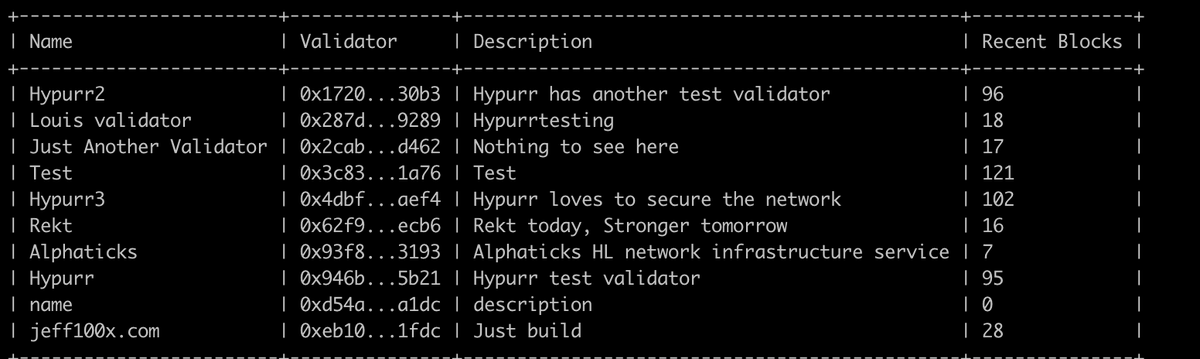
Grateful to build with such a passionate community. Never been more excited about the road ahead
Jeff · X · 2024-08-26 04:31 UTC
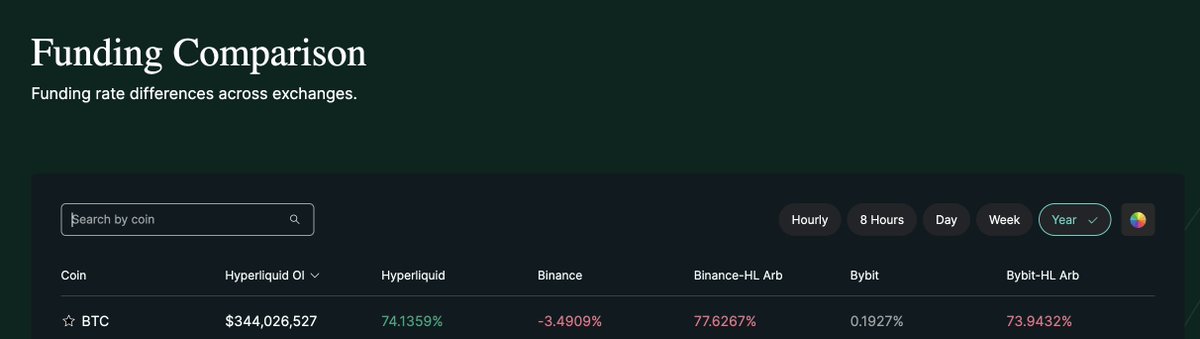
BTC OI is growing rapidly on @HyperliquidX and the automated arbers haven't sized up for several hours Could be a decent manual opportunity available in size
Jeff · X · 2024-07-05 08:40 UTC
During extreme volatility like today, @HyperliquidX is often the most liquid venue across DEXs and CEXs. Even on majors like ETH perps. Liquidity has a reputation for disappearing when users need it the most. The more efficient the market, the more pronounced this effect. It's a fair pricing of adverse selection by toxic takers. Conventional wisdom says it's an unavoidable side effect of the order book model. But this is lazy thinking. The market structure and underlying infrastructure should be optimized to best serve the end user. By redesigning the L1 from first principles, Hyperliquid proves that jointly optimizing the full stack leads to tangible benefits for all users.

Jeff · X · 2024-05-29 16:48 UTC
integrationReminder: the Hyperliquid dev team does not profit from increased activity as it does not collect trading fees. On the contrary, it is entirely self-funded with exponentially increasing burn. There is not a single private investor. >$25M of revenue has gone back to the community through HLP. Another project could have easily pocketed some or all of these profits. What’s the point of all this? To build something that really matters. When finance moves onchain, it will bring trillions of dollars of value to billions of users. It won’t move for a half-baked system, but the Hyperliquid L1 has a shot. Some users think that Hyperliquid is already a complete platform. This is flattering, and the Hyperliquid community is indeed one-of-a-kind! But as someone spending most waking moments pushing Hyperliquid to its full potential, I’m confident that there is a long way to go. In particular, the following are all complex, multi-phase undertakings: 1) deploying the native EVM 2) seamlessly integrating the EVM with existing native components (e.g., order books) 3) fully decentralizing the network On top of that, the following are continuously being improved: 1) high TPS and low latency L1 with HyperBFT consensus 2) performant financial primitives including fully onchain spot and perp order books, vaults, oracles, automated liquidity and account abstractions 3) state-of-the-art and community-owned order book liquidity via HLP When you see a 100x, you drop everything to make that a reality. Factors of <2 are insignificant. Big things take time to build, but nothing else is worth building.

Jeff · X · 2024-05-05 15:19 UTC
The Hyperliquid L1 will be transitioning to HyperBFT, a custom consensus algorithm written from the ground up. The implementation is in final stages of testing on testnet. The mainnet migration is expected to happen in the coming weeks. The Hyperliquid L1 is one of a few chains in production with real demand above 20k TPS. With a scope expanding far beyond perps trading (more on that later), it is crucial to optimize the foundational consensus algorithm. Like most modern consensus algorithms, HyperBFT is based on Hotstuff and subsequent improvements. Huge thanks to the researchers who continue to push the boundaries of what is possible on a decentralized state machine. Some properites of HyperBFT: 1) TPS will be massively improved. The current bottleneck for the Hyperliquid L1 is Tendermint, which caps out at 20k orders/second. HyperBFT can support up to 100x the throughput, though in practice the state machine execution will be a bottleneck at around 200k orders/second. 2) Consensus does not block on execution. Unlike Ethereum and Tendermint, the consensus algorithm can continue sequencing transactions without waiting for the hash of the current block being executed. 3) Confirmation latency will improve and stabilize, with block times bounded only by the network delay. Unlike earlier BFT algorithms such as Tendermint, there is no synchronous timescale baked into the consensus algorithm itself under normal block production. Blocks are produced as quickly as a quorum of validators can communicate. This property is sometimes called "optimistic responsiveness." The mainnet rollout will be incremental, focusing first on stability at performance parity with the current L1 before cranking up throughput.
Jeff · X · 2024-05-03 13:33 UTC
First time I've seen Hyperliquid pay to long BTC and ETH perps 60% APR if hedging on Binance
